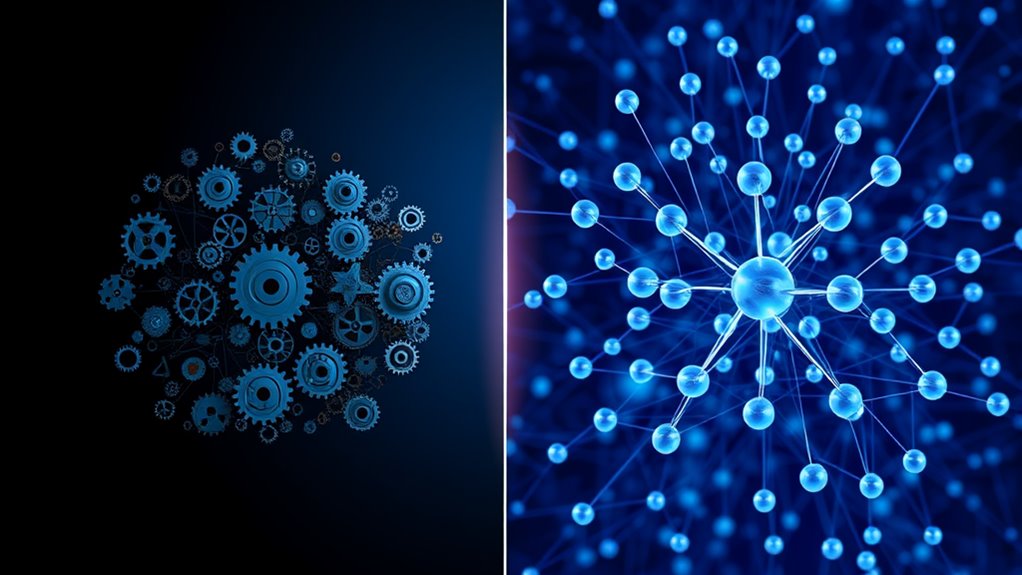
Machine learning and deep learning are both subsets of artificial intelligence, yet they differ fundamentally in their approach to pattern recognition, architecture, and data requirements, leading to distinct applications and use cases. Machine learning focuses on pattern recognition in data using supervised and unsupervised learning, whereas deep learning utilizes neural networks with multiple layers to learn nuanced patterns. Deep learning requires larger datasets and resources, and its applications excel in image and speech recognition, natural language processing, and more. As you explore the intricacies of these technologies, you'll uncover more nuances that differentiate them and illuminate their unique strengths.
Machine Learning Fundamentals
Machine learning, a subset of artificial intelligence, can be likened to a skilled librarian, tasked with categorizing and retrieving vast amounts of information. This process involves training algorithms to recognize patterns in data and make predictions or decisions based on that data. There are two primary types of machine learning: supervised learning and unsupervised learning. Supervised learning involves training an algorithm on labeled data to predict outcomes, whereas unsupervised learning involves identifying patterns in unlabeled data.
Effective machine learning requires several key components, including feature extraction, which involves selecting the most relevant data points to use in training an algorithm. Algorithm selection is also important, as different algorithms are suited to different types of data and problems. Model evaluation is vital to confirm that the chosen algorithm is performing well, and techniques such as cross-validation can be used to prevent overfitting, where an algorithm becomes too closely customized to the training data.
To prevent overfitting and confirm the accuracy of a machine learning model, techniques such as regularization and early stopping can be employed. Furthermore, techniques such as data augmentation and ensemble methods can be used to improve model performance. By comprehending these fundamental concepts and techniques, developers can build effective machine learning models that can be used to solve a wide range of problems. By applying these concepts, machine learning can be a significant tool for analyzing and making decisions based on complex data.
Deep Learning Architecture
As the complexity of data increases, traditional machine learning algorithms can be limited in their ability to derive meaningful insights. This limitation has led to the development of deep learning architectures, which are particularly designed to handle complex data sets. At the heart of deep learning lies the concept of neural networks, which are composed of multiple layers of interconnected nodes or "neurons." These nodes process and transform inputs, enabling the network to learn and represent complex patterns and relationships.
Deep learning architectures can be broadly categorized into three types: feedforward networks, convolutional neural networks (CNNs), and recurrent neural networks (RNNs). Feedforward networks are the simplest type, where data flows only in one direction, from input layer to output layer. CNNs are designed for image and video processing, whereas RNNs are suited for sequential data such as text and speech. These neural networks are widely used in various applications, from computer vision to natural language processing. Understanding their differences and use cases is crucial for selecting the appropriate model for a given task. For those looking to dive deeper into the topic, there are many resources available that have neural networks explained in detail.
The model complexity of deep learning architectures is a key factor in their ability to learn from complex data. By increasing the number of layers and nodes, the model can capture more nuanced patterns and relationships. Nevertheless, this increased complexity also requires larger amounts of training data and computational resources. As a result, deep learning architectures often require careful tuning and refinement to achieve the best performance. By leveraging the strength of neural networks and managing model complexity, deep learning architectures can reveal insights from complex data sets that traditional machine learning algorithms cannot.
Data Requirements Comparison
Typically, a viable comparison between machine learning and deep learning requires a thorough examination of their respective data requirements. One key difference lies in the data volume needed to train each type of model. Deep learning models typically require a massive amount of data to learn complex patterns and relationships, whereas machine learning models can often perform well with smaller datasets.
This disparity in data requirements is largely because of the way these models process data. Deep learning models rely on automatic feature learning, which involves using neural networks to extract relevant features from raw data. Conversely, machine learning models rely on manual feature engineering, which can be more efficient but likewise more labor-intensive.
The following points highlight the implications of these differing data requirements:
- *Large-scale data collection efforts are often necessary for deep learning projects, which can be costly and time-consuming.*
- *The need for manual feature engineering in machine learning can lead to biased or incomplete feature sets, which can negatively impact model performance.*
- *The ability of deep learning models to learn from raw data can lead to more robust and generalizable models, but similarly increases the risk of overfitting to the training data.*
Training Process Differences
The training process lies at the heart of both machine learning and deep learning models, where raw data is transformed into actionable knowledge. A significant distinction between the two lies in the complexity and duration of their training processes. Machine learning models typically require less data and computational resources, resulting in shorter training times. They often rely on traditional algorithms such as decision trees, random forests, and support vector machines, which can be trained quickly and efficiently.
In contrast, deep learning models require vast amounts of data and computational resources to train, resulting in longer training times. This is because of the complexity of their neural network architectures, which consist of multiple layers of interconnected nodes. Deep learning models can be trained using both supervised and unsupervised learning methods. Supervised learning involves training the model on labeled data, where the correct output is already known. Unsupervised learning, conversely, involves training the model on unlabeled data, where the model must discover patterns and relationships on its own.
The choice of training method and model architecture depends on the specific problem being tackled and the type of data available. Machine learning models are often preferred for smaller datasets and less complex problems, whereas deep learning models are better suited for larger datasets and more complex problems.
Real World Applications
Machine learning and deep learning models have numerous real-world applications across various industries, leveraging their unique strengths to drive innovation and solve complex problems. From healthcare and finance to transportation and customer service, the influence of these technologies is becoming increasingly pronounced.
Deep learning models, with their ability to learn hierarchical representations of data, have been particularly successful in applications involving image and speech recognition. For instance, image recognition capabilities are being utilized in self-driving cars to detect and respond to their surroundings. Meanwhile, natural language processing (NLP) has transformed the way we interact with virtual assistants, such as Siri and Alexa, and enabled more accurate language translation services.
Some notable examples of real-world applications include:
- *Virtual health assistants*: AI-driven chatbots are being used to provide patients with personalized health advice and support, helping to alleviate the burden on healthcare professionals.
- *Predictive maintenance*: Machine learning algorithms are being used to analyze sensor data from industrial equipment, enabling companies to predict when maintenance is required and reduce downtime.
- *Intelligent customer service*: Deep learning models are being used to drive chatbots and virtual assistants, providing customers with quick and effective support and improving overall customer satisfaction.
Frequently Asked Questions
Can Humans Learn From Machine Learning Algorithms?
Steering through the vast ocean of data, machine learning algorithms can be a guiding lighthouse, illuminating patterns and trends. As humans interact with these algorithms, they can certainly learn from them. By analyzing the output of algorithmic learning, humans can gain valuable insights, refining their grasp of complex phenomena. This synergy enables humans to leverage machine-driven findings and integrate them with their own insights, nurturing a deeper comprehension of the world around them.
Is Deep Learning Suitable for Small Datasets?
When considering deep learning for small datasets, it is crucial to understand its data requirements. Deep learning models typically require large amounts of data to train accurately, as their complexity demands extensive information to learn from. Nonetheless, this model complexity can lead to overfitting in smaller datasets, resulting in poor generalization. To overcome this, techniques such as data augmentation, transfer learning, or using simpler architectures can be employed to adapt deep learning to smaller datasets.
Can Deep Learning Models Be Transparent?
Transparency in deep learning models is a pressing concern, as complex neural networks can be difficult to interpret. Model interpretability and algorithm transparency are crucial for comprehending how these models arrive at their predictions. Techniques such as feature attribution methods, saliency maps, and layer-wise relevance propagation can help shed light on deep learning model decision-making. By incorporating these methods, researchers can increase transparency and trust in deep learning model outputs.
How Do I Choose Between Machine Learning Libraries?
When selecting a machine learning library, consider several key factors to guarantee the best fit for your project. Evaluate library performance regarding computation speed and efficiency. Assess the user experience, including ease of use, documentation quality, and community support. Model selection capabilities and data preprocessing tools should additionally be considered. By weighing these factors, you can choose a library that streamlines your workflow and optimizes your machine learning tasks.
Can Machine Learning Replace Human Intuition?
Although machine learning can analyze vast amounts of data to inform decision-making, it is unlikely to fully replace human intuition. Human intuition often involves pattern recognition, creativity, and experience-based judgments that are difficult to replicate with algorithms alone. Nevertheless, machine learning can complement human intuition by providing data-driven decisions and augmenting intuitive insights. By combining the strengths of both, organizations can make more informed, strategic decisions. Effective integration requires comprehending the limitations and capabilities of each.